
Simply Classic Le Petit Negre Claude Debussy Alfred 14351


Simply Classic Le Petit Negre Claude Debussy Alfred 14351
Le Petit Nègre (Cakewalk)
By Claude Debussy / arr. Allan Small
Series: Simply Classics Solos
Category: Piano Solo
Format: Sheet
Instrument: Piano
Level: Late Intermediate
A "cakewalk" is an African-American dance that began in the 1800s and became popular in minstrel shows at the turn of the 20th century. It features syncopated, ragtime-like music to which a couple struts arm and arm using high steps. Debussy wrote Le petit Nègre in 1909 for another composer's elementary piano method. He closely modeled it after his successful "Golliwog's Cakewalk," the conclusion of his six-movement suite, Children's Corner, composed the previous year.
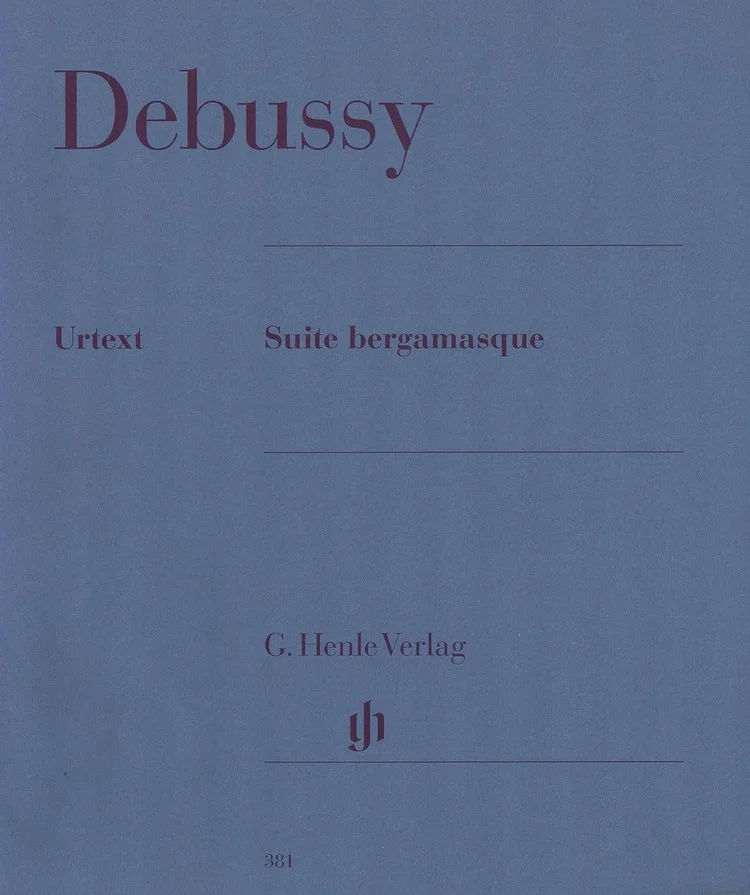
Suite bergamasque
Piano Solo
Series: Henle Music Folios
Publisher: Henle Urtext Edition
Format: Softcover
Composer: Claude Debussy
Editor: Ernst-Günter Heinemann
Although it was only published in 1905, Debussy made it clear that this was an early work by writing the date of composition “1890” on the proofs. He had sold the manuscript, now lost, to the publisher Choudens in 1890 without it actually being published. Yet the delayed publication date shows that Debussy was still very convinced of the value of the work. The composition has four movements and became popular in particular on account of the slow movement Clair de lune (HN 391), which seems to evoke the atmosphere of a moonlit night with its particular aura. Countless transcriptions for various groups of instruments demonstrate the unbroken popularity of the piece, but also of the complete suite.

12 Études
Piano Solo
Series: Henle Music Folios
Publisher: Henle Urtext Edition
Format: Softcover
Composer: Claude Debussy
Editor: Ernst-Günter Heinemann
Debussy composed this cycle, and other masterful late works, in the summer of 1915. He had withdrawn to a country house near Dieppe with his family and composed with fevered concentration. The self-critical composer was very proud of his Études: “I confess that I am pleased to have created a work which – false vanity aside – will occupy a special niche. In point of technique these Études will usefully prepare pianists for a better understanding of the fact that the portals of music can only be opened with formidable hands.” Debussy's Études are today a milestone along the path of those desirous of becoming concert pianists.
Width: 9.25"
Length: 12.25"
90 pages
6 Epigraphes Antiques
Piano Solo
Series: Henle Music Folios
Publisher: Henle Urtext Edition
Format: Softcover
Composer: Claude Debussy
Editor: Ernst-Günter Heinemann
Around 1900 Debussy composed 12 short pieces for two flutes, two harps and celesta as incidental music for the Chansons de Bilitis (recitation of ancient Greek poems by the courtesan Bilitis) by Pierre Louÿs. Although it was performed, the work was not published during Debussy's lifetime. The composer highly valued the work and returned to it in 1914, choosing six of the old pieces and reworking them into an important new cycle for piano four hands (HN 408). At the same time he also completed a version for piano solo (HN 402). Debussy succeeded to transform the delicate incidental music into a colourful, sonorous piano setting in both versions.
Width: 9.25"
Length: 12.25"
28 pages
Masques
Piano Solo
Series: Henle Music Folios
Publisher: Henle Urtext Edition
Format: Softcover
Composer: Claude Debussy
Editor: Ernst-Günter Heinemann
Width: 9.25"
Length: 12.25"
20 pages
Estampes
Piano Solo
Series: Henle Music Folios
Publisher: Henle Urtext Edition
Format: Softcover
Composer: Claude Debussy
Editor: Ernst-Günter Heinemann
With the three movements Pagodes, La soirée dans Grenade (An evening in Granada) und Jardins sous la pluie (Gardens in the rain) Debussy creates a poetic world of landscapes and distant lands in the cycle Estampes. He composed the pieces in summer 1903 while he was staying in Bichain in the north of Burgundy. As he wrote in a letter at the time: “If one cannot afford to travel, one substitutes the imagination.” In the virtuosic final movement he draws on his pioneering Images from the year 1894 (HN 846).
Images – 2e Série
Piano Solo
Series: Henle Music Folios
Publisher: Henle Urtext Edition
Format: Softcover
Composer: Claude Debussy
Editor: Ernst-Günter Heineman
The cycle with three movements, composed at the end of 1907 and published at the beginning of the next year, contains a singular innovation: Debussy notated the highly differentiated piano part that goes into the extreme registers on three staves. The first movement (Cloches à travers les feuilles) is reminiscent of a deathknell, the second (Et la lune descend sur le temple qui fut) conjures up far-off India or also China; and as for the third movement (Poissons d'or) Debussy was inspired by an enamel painting of goldfish in his study. The dedicatee of the third movement, Ricardo Viñes, gave the first performance of the cycle.
Width: 9.25"
Length: 12.25"
38 pages
Gaby Casadesus
International Music Company 3421